Constraints and bearings
After completing this chapter, you should be able to:
- Identify different types of supports (rollers, hinges, fixed) and their constraint degrees
- Calculate the degree of static determinacy \(D = 3n - \sum c_i\) for 2D structures
- Determine the instantaneous center of rotation to verify if constraints are properly placed
Constraints and degrees of freedom
The condition of static equilibrium that we discussed in Chapter 1 does not mean that the body is immovable. As you saw in the previous section, the body still can translate and rotate; in a two-dimensional case an object can have three kinematics degrees of freedom (DoFs): two orthogonal translational displacements along x- and y- axes, and one rotation around z-axis. The motion of the body can be constrained by eliminating some DoFs with the help of supports (Figure 1). Depending on the type of support, one, two, or all three DoFs can be removed. The kinematic constraints imposed by supports trigger so-called reaction forces, or simply reactions. Note that if exactly all degrees of freedom are removed, the system is called statically determinate or isostatic.
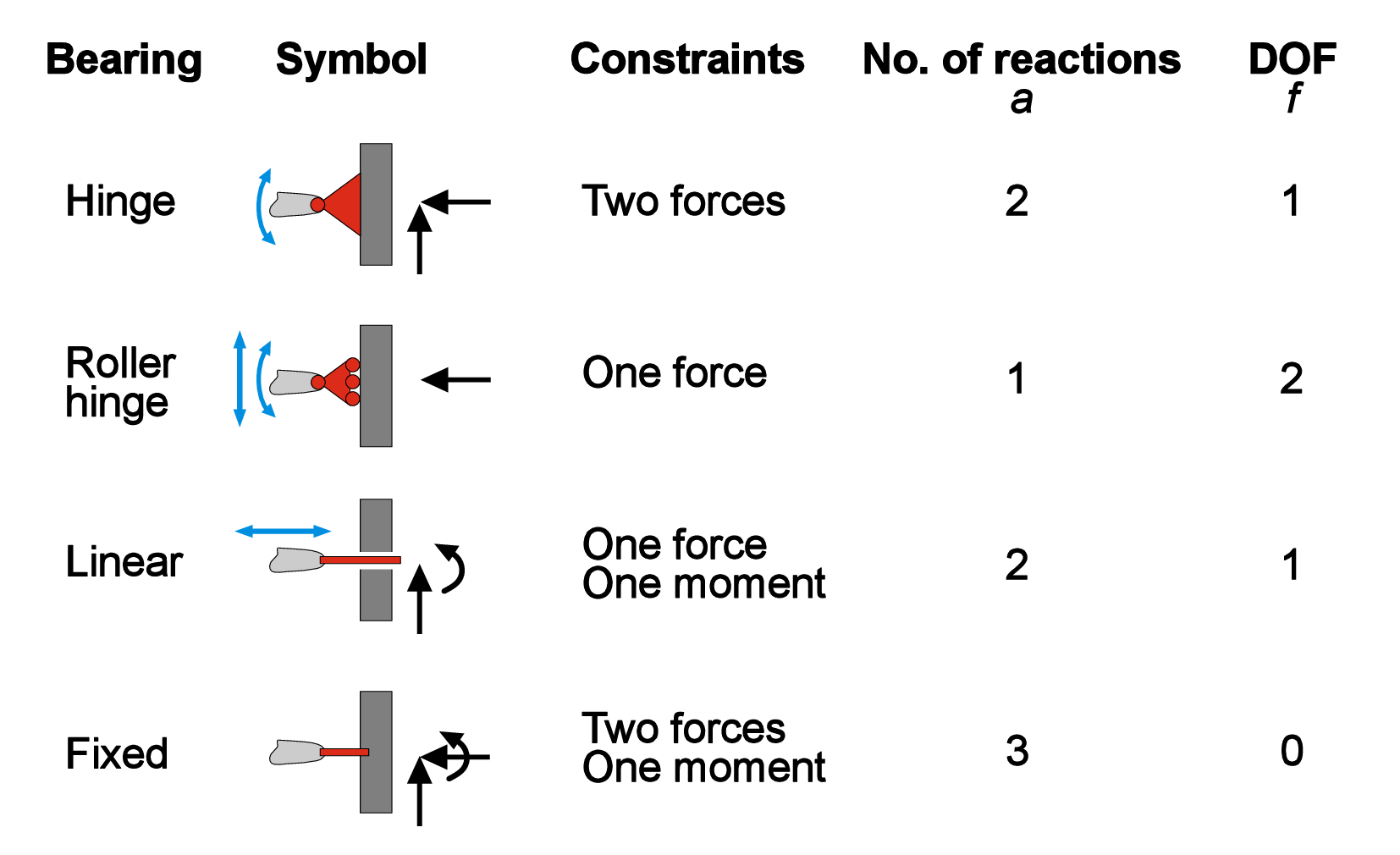
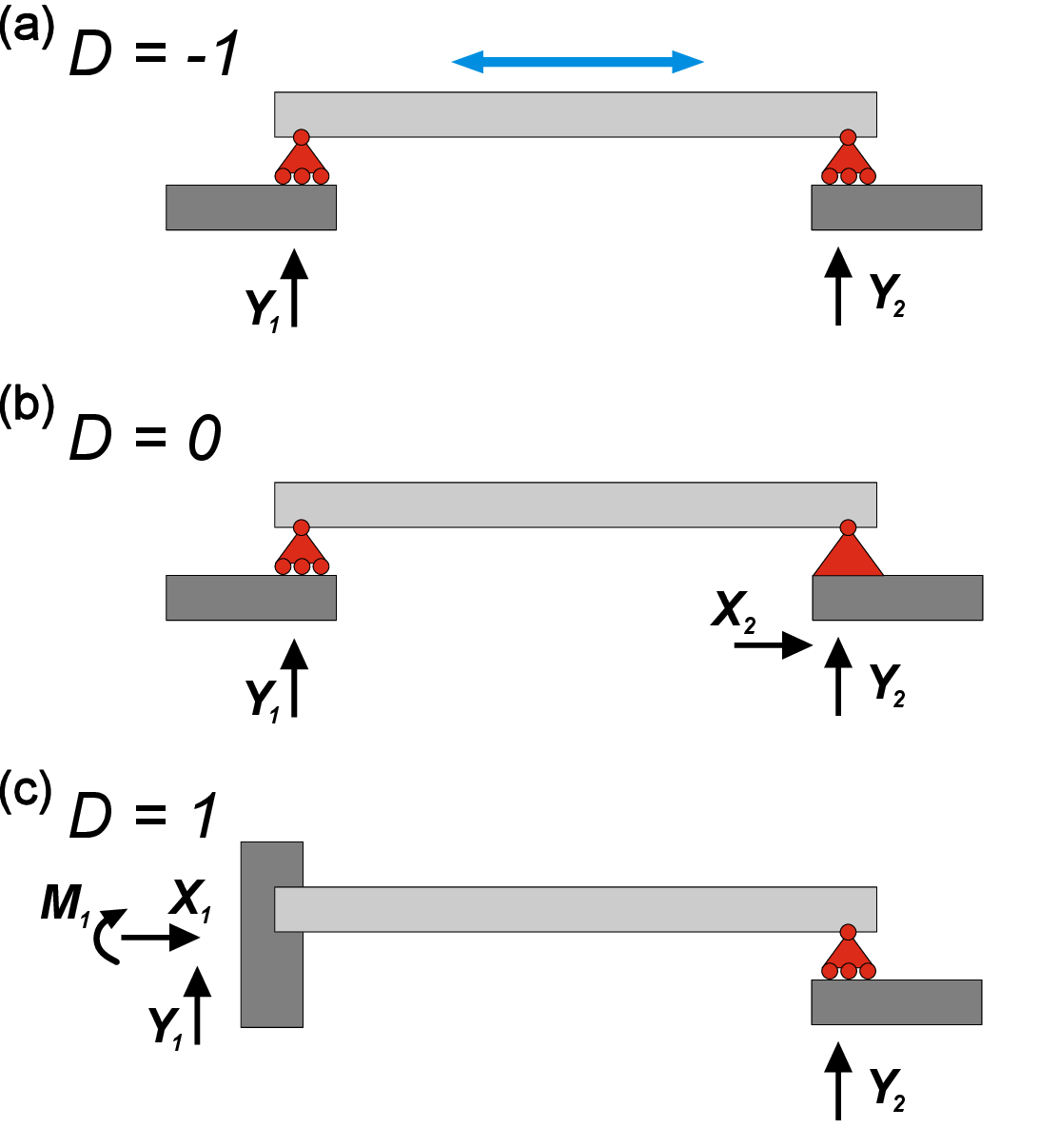
As you can see, the sum of the degrees of constraints \(c_i\) and DoFs \(f_i\) is always equal to 3 (for 2D case). This is a necessary (but not a sufficient!) condition for a statically determinate system with one body and \(m\) constraints. Namely, \[3-\sum _{i}^{m}{c_i}=0 \]For more general 2D system with \(n\) connected bodies \[3n-\sum _{i}^{m}{c_i}=0. \] By having \(n\) bodies, \(m\) constraints of degree \(c_i\), we can distinguish three different cases for 2D force systems defined by the value of \(D\), where \[D=3n-\sum _{i}^{m}{c_i} \label {eq:D} \]We know that a determinate (or isostatic) system must have \(D=0\) (Figure 2 b). If \(D>0\), then the system is movable or kinematically indeterminate since it has unrestricted DoF (Figure 2 a). If \(D<0\), then the system is called statically indeterminate or hyperstatic - the system is immovable and contains extra reactions that can be removed (Figure 2 c).
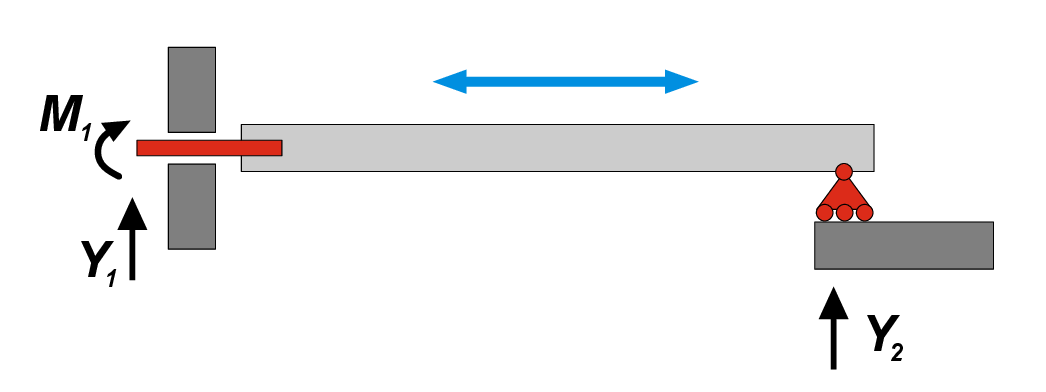
Again, we need to emphasize that above-mentioned mathematical precondition is a necessary, but not sufficient, requirement. One exception from this rule is the system with two and one reactions in the left and right supports respectively shown in Figure 3. Here, we have \(D=0\), which usually corresponds to determinate system. However, it is clear that the beam can move freely in a horizontal direction, therefore it has 1 DoF! In this specific case, force vectors \(Y_1\) and \(Y_2\) are parallel, and they both can compensate only vertical direction of action, while the horizontal movement is not restricted. It means that the constraints are ill placed. A systematic way to determine if constraints are well placed consists in determining the Instantaneous Center of Rotation.
Instantaneous Center of Rotation.
In planar (2D) kinematics, the Instantaneous Center of Rotation \(C\) is a point in or outside a rigid body about which the entire body appears to rotate at a given instant of time.
At that instant, all points of the body have velocities that are equivalent to those of a pure rotation about the \(C\).
Consider a rigid body moving in a plane. At any instant, the motion can be described as a combination of translation and rotation. The instantaneous center of rotation is defined as the point of the body (or its extension) that has zero velocity at that instant. \[v_{C} = 0\] All other points of the body move as if rotating about this point.
Let the body have an angular velocity $$ (positive counterclockwise). If \(P\) is a point on the body and \(r_{P/C}\) is the position vector from the \(C\) to \(P\), the velocity of \(P\) is given by \[\vec{v}_P = \vec{\omega } \times \vec{r}_{P/C}\] In planar motion, this reduces to the scalar relation: \[v_P = \omega \, r_{P/C}\] where \(r_{P/C}\) is the distance between \(P\) and the instantaneous center.
If the instantaneous center of rotation is located at infinity, the motion is a pure translation without rotation (if \(r_{P/C} \to \infty\) then $ $).
Thus, given an assembly of rigid bodies, it is appropriate to verify the existence of \(C\) in order to determine if a structure is really static (\(D\le 0\)) or if some constraints are ill placed, as in the example of Figure 3.
The existence of \(C\) can be determined by looking at the constraints. Single constraints allow for infinite possible centers of rotations: all the points of the line perpendicular to the direction of motion of the roller, and all the points at the infinity for the rotation lock. Double constraints allow only one center of rotations: the center of the hinge or the point at the infinity in the direction perpendicular to the movement of the linear bearing. Triple constraints do not allow any possible center of rotation.
For a single constrained rigid body, if there is a point in common among all possible instantaneous centers of rotations of each constraint, that point is \(C\) and
the body is kinematically indeterminate. For example, in the structure depicted in Figure 3, the linear bearing admits only one possible \(C\) at the infinity, in the direction perpendicular to axis of the beam, and the roller allows infinite ICRs normal to the roller, including of course the point at the infinity. Thus, both constraints admit \(C\) at the infinity perpendicular to the beam, which is indeed the point around which the beam can freely rotate (i.e. the beam can translate rigidly horizontally).
When moving from a single beam to systems of rigid bodies, it becomes necessary to distinguish between different definitions of the instantaneous center of rotation:
The absolute center of rotation, denoted as \(C_i\), is the point around which the \(i\)-th body rotates. This point is therefore fixed with respect to a global reference system, and its existence is only possible in mechanisms that are kinematically undetermined and statically impossible (\(D>0\)).
The relative center of rotation between two bodies is the point \(C_{ij}\) such that, when observing body \(i\) from a reference frame attached to body \(j\), the latter would appear to be at rest while the former rotates about \(C_{ij}\). External constraints affect the position of the absolute center, while internal constraints affect that of the relative center, in a way entirely analogous to what has already been discussed.
For an assembly consisting of two rigid bodies, we can use the first theorem of kinematic chains: given a structure consisting of two rigid bodies \(i\) and \(j\), a necessary and sufficient condition for it to be a mechanism is that the instantaneous centers of rotation \(C_i\), \(C_j\), and \(C_{ij}\) are aligned.
This chapter introduced structural constraints and static determinacy:
- Degrees of freedom (DoF): In 2D, a free rigid body has 3 DoFs (two translations, one rotation)
- Supports: Remove DoFs through constraints; rollers (1 constraint), hinges (2 constraints), fixed supports (3 constraints)
- Static determinacy: Computed via \(D = 3n - \sum c_i\) where \(D=0\) is isostatic, \(D>0\) is movable, \(D<0\) is hyperstatic
- Instantaneous center of rotation (ICR): A point about which a body instantaneously rotates; useful for verifying whether constraints are properly placed to prevent motion
Understanding structural constraints is essential for analyzing whether mechanisms can move and whether static structures are properly supported.